
Santorini Architecture Explained
Santorini’s architecture is inseparable from its landscape. Shaped by volcanic rock, strong winds, limited space and generations of island life, the buildings of Santorini were created not simply for appearance, but for practicality, protection and comfort.
From whitewashed cave houses built into the cliffs to elegant nineteenth-century mansions, the island’s architecture tells the story of the people who lived here long before Santorini became a world-famous destination.
Architecture Shaped by the Volcano
Santorini’s volcanic landscape provided both the challenge and the materials for building. On the caldera side of the island, homes were often built directly into the soft volcanic rock, creating structures that followed the natural shape of the cliff rather than imposing themselves upon it.
The thick walls and underground spaces offered natural insulation, helping homes remain cooler during the hot summer months and warmer during the winter. Small windows, shaded courtyards and simple forms also helped protect residents from the strong Cycladic winds.
This close relationship between architecture and landscape is one of the reasons Santorini feels so distinctive. The villages do not sit apart from the cliffs; they appear to grow from them.
Cave Houses: Practical and Ingenious
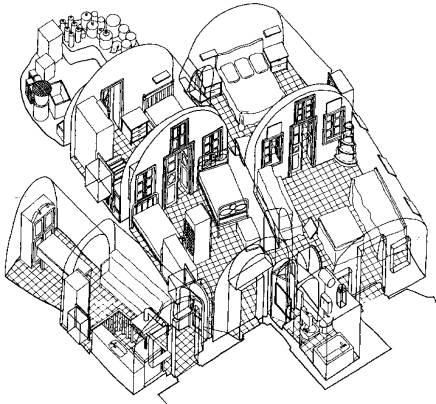
The traditional cave house, or ypóskapho, is one of Santorini’s most recognisable architectural forms. These homes were carved into the volcanic rock, usually with a long, narrow interior and a vaulted ceiling. Their simple façades opened onto terraces or shared courtyards, often looking towards the caldera.
Cave houses were especially common among working families, sailors and farmers. Their design made careful use of limited land while offering protection from the elements. Some were modest one-room homes, while others expanded over time as families needed more space.
Today, many of these historic dwellings have been carefully restored, allowing visitors to experience a form of island life that was both practical and deeply connected to Santorini’s natural environment.
Captain Houses and Neoclassical Influence
Not all of Santorini’s historic homes were carved into the cliff. In Fira and other prosperous settlements, wealthier merchant and sea-captain families built more substantial residences, particularly during the nineteenth century.
These houses often reflected neoclassical influences, with higher ceilings, more formal façades, decorative details and larger rooms. Their architecture expressed the island’s commercial links with other Mediterranean ports, while still adapting to Santorini’s local materials and terrain.
The contrast between the humble cave house and the more refined captain house reveals an important part of the island’s history: Santorini was not only an agricultural community, but also a place of trade, shipping and cultural exchange.
Villages Built for Community
Traditional Santorini villages were designed around everyday life. Narrow lanes provided shade and protection from the wind, while houses were built close together for security and to make the most of limited land. Churches, small squares, courtyards and family homes formed compact communities that were easy to navigate on foot.
In inland villages such as Pyrgos, Emporio and Megalochori, visitors can still see fortified quarters, winding paths and old houses shaped by centuries of local life. Along the caldera, Fira, Firostefani and Imerovigli offer a different expression of the same tradition, with homes cascading down the cliffside towards the sea.
Explore more of these distinctive places in our guide to Santorini’s Villages.
White, Blue and the Colours of Santorini
The familiar whitewashed surfaces and blue-domed churches have become symbols of the Cyclades, but Santorini’s traditional palette is more varied than it first appears. Earthy volcanic tones, ochre walls, pastel façades, dark stone and whitewashed courtyards all form part of the island’s visual character.
The simplicity of these buildings is also one of their strengths. Their forms are functional, but never plain: curved roofs, arched doorways, stepped terraces and domes create a soft, harmonious rhythm across the villages.
Discovering Santorini Through Its Buildings
Understanding the island’s architecture gives a deeper meaning to a stay in Santorini. A cave house is not simply a beautiful setting; it is an example of how islanders adapted to a demanding volcanic landscape. A neoclassical mansion reflects the wealth and confidence brought by maritime trade. A narrow village lane reveals the practical logic of community life in the Cyclades.
A walk through Fira is an excellent place to begin. Its churches, traditional homes, neoclassical buildings and caldera-side paths reveal many layers of the island’s architectural history. Read more in our guide to A Walk Through Fira.
Traditional Architecture at Aigialos
Aigialos is a collection of genuine historic residences in Fira, rather than a modern hotel designed to resemble traditional Santorini. Its cave houses, vaulted interiors, thick volcanic walls and neoclassical influences reflect the architectural heritage that shaped the island over generations.
Each residence has been carefully restored while retaining its original character, offering guests a more authentic connection to Santorini’s history and way of life. Discover more about traditional Santorini architecture at Aigialos.
Continue discovering the island through our guides to Santorini’s Archaeological Treasures, Santorini’s Wineries and The Volcano of Santorini.

| SANTORINI HOTEL Fira, 84700 Santorini Tel. (+30) 22860 25191-5 WhatsApp. (+30) 6972714346 hotel@aigialos.gr |
COMPANY DETAILS AIGIALOS Tourism Enterprises PLC 35, Akadimias Street, 10672 Athens GCR# 001629401000 Tel. (+30) 210 3636637 & (+30) 210 3626102 |